
Ragnarök: Destruction, Fate & Rebirth in Norse Tattoo Symbolism
Ragnarök isn’t just “the Viking apocalypse”, it’s the story of everything breaking so something new can exist. In the Eddas, we see wolves swallowing the sun and moon, the World Serpent rising from the sea, Fenrir breaking his chains, gods marching toward their deaths, and the world burning. But if you read closely, it’s not just about destruction. After the fire, a new earth rises from the water, green and alive. That’s what makes Ragnarök so powerful as a symbol: it’s about the endings we don’t walk away from unchanged, the chapters that burn everything down, and the rebirth that only comes after we’ve faced the hardest truths.
For tattoo clients, Ragnarök is almost never chosen lightly. People gravitate to this theme when they’ve hit rock bottom, survived trauma, walked through divorce or addiction, buried parts of their old life, and started over. Ragnarök tattoos become a way to mark that journey, not just the pain, but the rebuild. Whether it’s Fenrir versus Odin, Thor battling Jörmungandr, Surtr striding through flame, or a more subtle design like broken runes, falling knotwork, or a fractured serpent circle, these pieces are about claiming your story: “This is what I went through. This is who I became.” It’s not doom at all — it’s transformation, carved into skin.
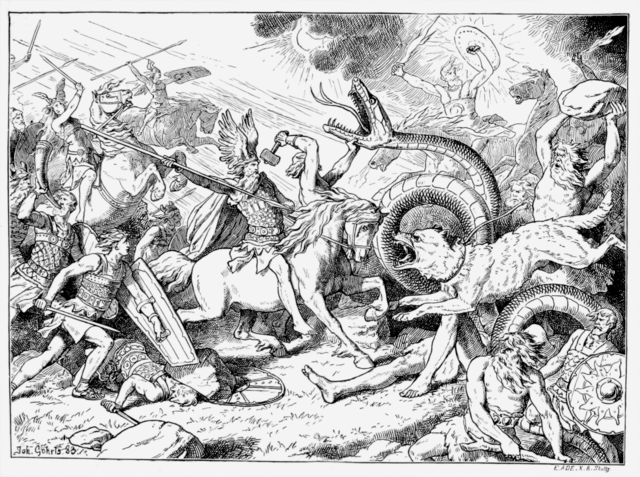
Ragnarök: The End That Gives Birth to Everything New
When people talk about Ragnarök, they usually focus on the destruction — the fire, the battles, the gods falling one by one. But if you dig into the Eddas, you’ll find something deeper, more human, and more meaningful.
Ragnarök isn’t just the end.
It’s a transition.
A leveling.
A clearing of what can no longer stand.
A painful, necessary ending that allows something new to take root.
For many people getting tattoos, Ragnarök becomes a symbol of:
Surviving the worst
Letting go of the past
Rebuilding after destruction
Facing fate without flinching
Becoming someone new
It’s a powerful story because it mirrors the hardest chapters of human life.
What Ragnarök Actually Is in the Norse Sources
The word “Ragnarök” comes from:
ragna — “the ruling powers” or “the gods”
rök — “fate, destiny”
So the meaning is:
“The fate of the gods.”
Not “the end of the world” in the Christian sense — but a cosmic cycle.
In the Poetic Edda (especially Völuspá), a seeress describes:
The breaking of oaths
The howling of wolves
The world-tree shaking
Fire and frost surging
The gods marching into their final battle
But in the same poem, after everything burns, she sees a new earth rising from the water, green and renewed.
The story isn’t just doom.
It’s rebirth.
Key Figures of Ragnarök (and Their Tattoo Symbolism)
Fenrir
Breaks his chains and kills Odin.
Represents the unstoppable force of truth and the collapse of old structures.
Jörmungandr
The World Serpent rises from the sea and fights Thor.
Symbol of cycles, endings, poison, and inevitable confrontation.
Thor
Kills the serpent but dies from its venom.
Symbol of sacrifice and courage in the face of fate.
Odin
Faces Fenrir knowing he cannot win.
Symbol of wisdom, acceptance, and leadership even in the face of death.
Surtr
Leads the fire giants and burns the world.
Represents cleansing, transformation, and destructive renewal.
The Sun & Moon Wolves (Sköll & Hati)
Swallow the celestial bodies.
Symbolic of endings that were always coming.
These aren’t villains or heroes — they’re forces of reality.
The Symbolism of Ragnarök for Modern Tattoo Clients
People who choose Ragnarök themes in tattoos are almost always marking a major chapter in their lives. This isn’t a casual symbol. It’s a milestone.
Here are the meanings that show up most often:
Endings That Made You Who You Are
Ragnarök symbolizes the kind of endings people don’t walk away from unchanged:
Divorce
Trauma
Addiction
Grief
Identity shifts
Rock-bottom moments
Childhood wounds
Major personal upheavals
It’s a mark of transformation.
Rebirth
After the fire and the fall, a new world rises.
Many clients get Ragnarök tattoos to mark the moment they started rebuilding themselves.
Confronting the Inevitable
Ragnarök is about facing fate head-on — no denial, no running, no fear.
Accepting Change
Everything ends.
Everything shifts.
Everything cycles.
Ragnarök tattoos become a symbol of emotional maturity and acceptance.
Warrior Spirit
Not violence — but courage.
Facing the storms.
Owning your truth.
Walking toward the hard things.
Claiming Your Power
Some clients resonate with Fenrir, some with Jörmungandr, some with Thor or Odin.
Each figure represents a different part of the psyche.
Ragnarök Tattoos: Design Approaches
There are countless ways to capture Ragnarök in tattoo form, from minimalist symbols to full saga scenes.
Fenrir vs. Odin
A powerful moment of fate and confrontation.
Often done as:
Full sleeve
Chest piece
Back piece
Thor vs. Jörmungandr
The final clash — lightning against chaos.
Works beautifully in dramatic blackwork or illustrative realism.
Surtr with His Flaming Sword
Walking through fire, world burning behind him.
Symbol of transformation and necessary endings.
Yggdrasil Swaying at the End
The World Tree shaking, roots splintering — a symbolic nod to ancient cycles.
Minimalist Ragnarök Symbolism
For people who want subtlety:
Broken runes
Fallen branches
Knotwork unraveling
A serpent circle fractured
A single wolf silhouette swallowing the sun
Full Ragnarök Sleeve
Upper arm to wrist narrative, including:
Wolves
Fire
Serpent
Gods
Spears
Rune rings
Crumbling knotwork
A saga carved into the skin.
Ragnarök Horizon Landscape
A wide, cinematic back piece:
Burning sky
Ship silhouettes
Feral wolves
Serpent coils rising from the sea
Figures walking toward their fate
This one is meant for people who want a true statement.
Placement Ideas
Full back
Chest
Rib panel
Full or half sleeve
Thigh
Calf
Shoulder-to-shoulder panorama
Forearm (scene or symbolic variant)
===========================================
Sources & Citations
Primary Sources
Poetic Edda, Völuspá — the main Ragnarök prophecy
Poetic Edda, Vafþrúðnismál — fate of the gods
Prose Edda, Snorri Sturluson — extended account of Ragnarök
Academic Works
Lindow, John — Norse Mythology
Simek, Rudolf — Dictionary of Northern Mythology
Davidson, H.R. Ellis — Gods and Myths of Northern Europe
Orchard, Andy — Dictionary of Norse Myth and Legend
Price, Neil — The Viking Way
Cultural Commentary
University of Iceland, Old Norse studies
Jackson Crawford, PhD — Ragnarök insights & linguistic context
===========================================
Author Bio - Jon Poulson, Ancient Marks
Jon Poulson is the founder of Ancient Marks, and one of the few tattoo artists in North America specializing in historically grounded Norse, Celtic, and ancestral tattoo styles. With over 20 years of experience in this style, Jon creates custom story-driven designs rooted in authentic symbolism, cultural respect, and artistic excellence. Clients travel nationally for Nordic-inspired work, bind-runes, and large-scale, geometric inspired and Tribal style tattoos.
