
Elder Futhark Runes: The Complete Guide to Norse Rune Tattoos
Among all Norse symbols, the Elder Futhark runes remain the most frequently requested and the most misunderstood in tattoo culture. Their power, mystique, and cultural weight have inspired people for centuries—and today they are among the most personal and symbolically loaded Nordic tattoo motifs.
A Cornerstone Article of the Nordic Tattoo Master Series
There is so much to be said about the Elder Futhark runes. Songs have been written of them, stones have been carved with them, and countless lives have been guided by their symbols for over a thousand years. For many, runes carry deep personal meaning—markers of identity, intention, ancestry, and transformation. For others, they appear mysterious or foreign, their true purpose lost beneath modern misconceptions and surface-level interpretations. What often gets missed is that these symbols were never meant to be aesthetic decorations alone—they were language, prayer, oath, and story combined into form.
This article exists to dig beneath the surface of the runes and reconnect them to their historical roots and living power. Rather than offering shallow lists or trendy symbolism, the goal here is to explore what the runes truly were, how they were used, and why they still resonate so strongly today—especially in tattooing. Whether you’re drawn to a single rune, a protective bindrune, or a deeply personal Norse composition, understanding their authentic meanings adds intention and integrity to the art you carry on your skin.
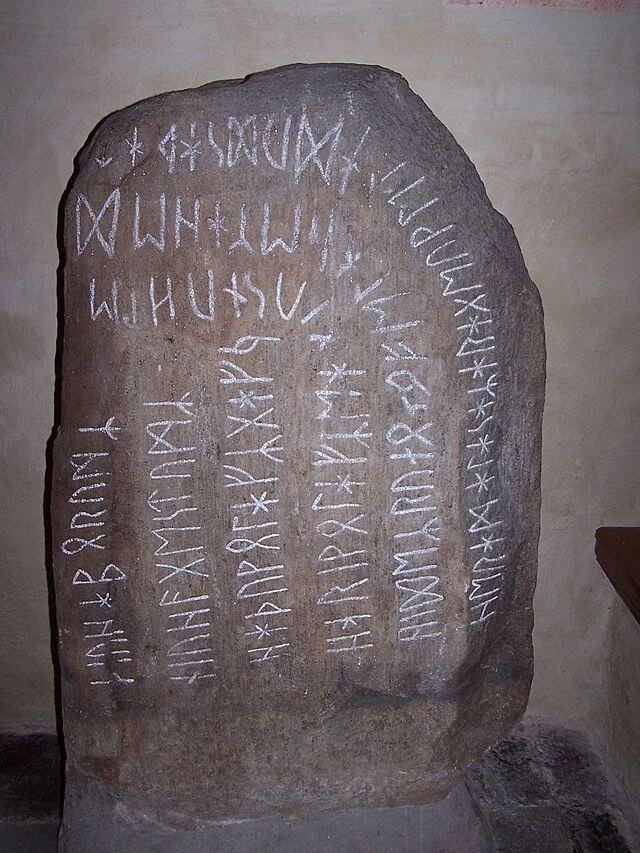
The Stentoften Runestone, an example of runes carved in stone.
Where do the Elder Futhark Runes come from?
In Norse mythology, the runes were not invented by humans… they were found.
According to the Hávamál, Odin sacrifices himself on the World Tree, hanging for nine nights “wounded with a spear, given to Odin, myself to myself.” In this trance between life and death, he glimpses the runes in the depths below, seizes them with a scream, and rises back to the world with the secrets of writing, magic, and meaning. In the mythic worldview, runes are gifts of insight pulled from the fabric of the universe — symbols of wisdom earned through sacrifice, suffering, and deep personal transformation. That’s why so many people today connect to runes not as simple letters, but as signs tied to resilience, shadow work, and awakening.
Historically, the story is different, but no less interesting.
The Elder Futhark appears across Northern Europe between the 2nd and 8th centuries CE, likely evolving from early Italic or Mediterranean alphabets adapted by Germanic tribes into their own symbolic system. Over time, runes shifted from a writing method to tools of meaning-making, ritual, memorial stones, personal identity, and magical practice. Archaeologists have found them carved into combs, weapons, amulets, jewelry, and stones from Denmark to Germany to Sweden — each inscription offering a tiny window into the culture and mindset of early Germanic peoples. So whether you look at runes through the lens of mythology or archaeology, both roads lead to the same truth: runes have always been more than markings. They are symbols of identity, intention, power, and connection — which is why they remain such powerful tattoo motifs today.
Introduction: Why Rune Tattoos Matter
Among all Norse symbols, the Elder Futhark runes remain the most frequently requested and the most misunderstood in tattoo culture. Their power, mystique, and cultural weight have inspired people for centuries—and today they are among the most personal and symbolically loaded Nordic tattoo motifs.
But the problem most clients face is this:
“What do the runes really mean? What are their true historical interpretations? And how do I avoid something inauthentic or incorrect?”
This guide answers all of that and more.
As part of the Nordic Tattoo Master Series, this article goes deeper than typical online rune lists. It is built from historical sources, archaeological references, linguistic research, and real-world tattoo experience at Ancient Marks, where clients travel nationally for custom Norse and rune-based work.
If you want a rune tattoo—whether a single rune, a protective stave, or a custom bindrune—this guide gives you a foundation built on accuracy and intention.
This guide won’t make the bindrune for you, but can serve as a guide when you bring your intentions to your artist to create a lasting personalized bindrune for you.
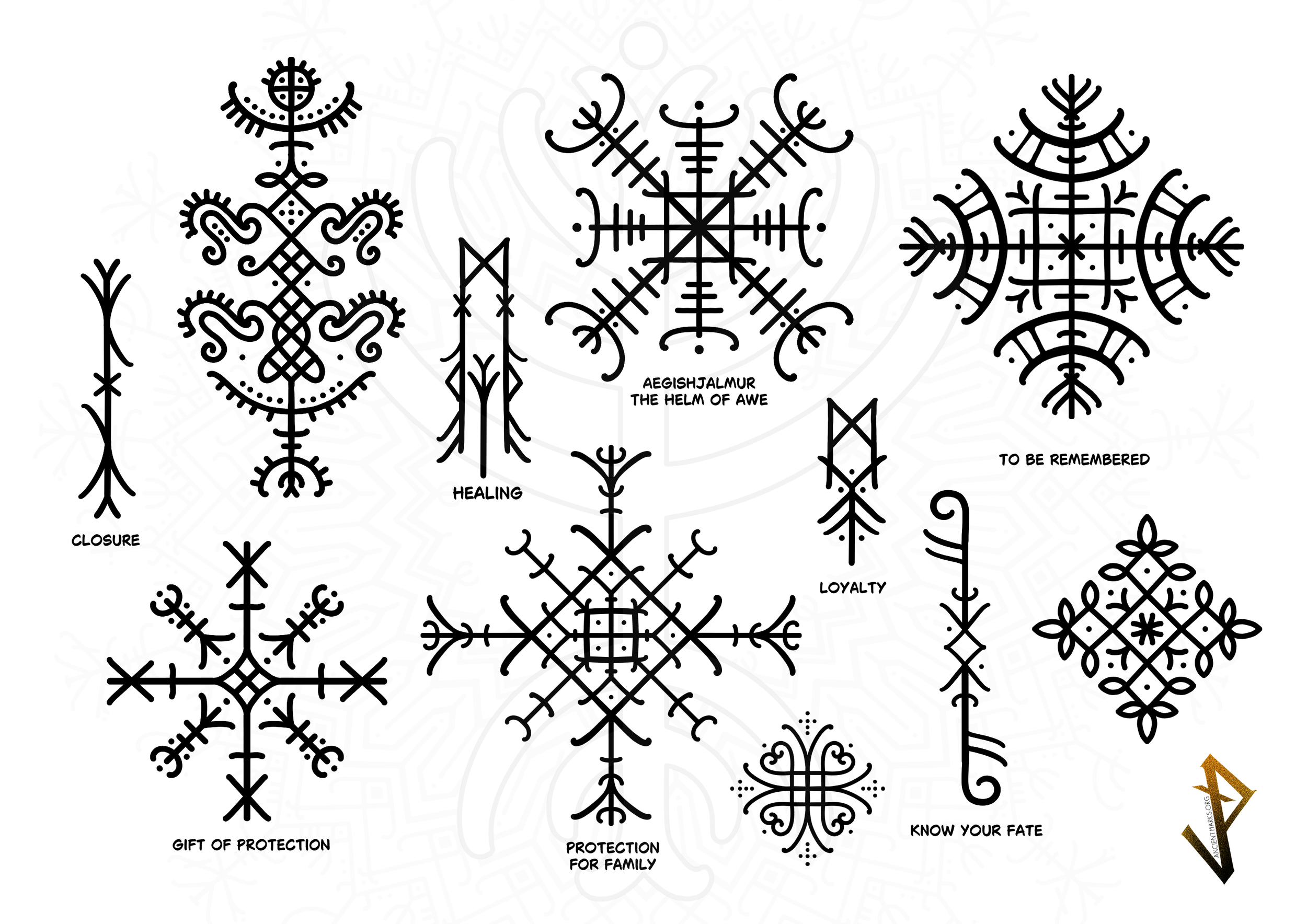
Various Sigils and Bindrunes with random designs… These are part of a FLASH set and available to you.
This artwork is ©2025 ANCIENT MARKS, LLC.
What Are the Elder Futhark Runes?
The Elder Futhark is the oldest known runic alphabet, used roughly from 150–800 CE across Scandinavia and Germanic Europe.
It contains 24 runes, divided into three families called Aetts:
Freyr’s Aett — Growth, vitality, expansion
Heimdall’s (or Hagal’s) Aett — Challenge, trials, transformation
Tyr’s Aett — Strength, order, justice, the warrior’s path
Each rune holds:
A phonetic value (sound)
A literal meaning (object or concept)
A symbolic meaning (spiritual or archetypal)
A historical context (as seen on stones and artifacts)
The runes are NOT:
A language you can “write English words” with
A direct translation system
A modern Wiccan symbol set
A simple decoration
They are an ancient writing + symbolic system that carried meaning on multiple levels. in fact, it is said that the god Oden gave his eye for the knowledge of these runes. But more on that in another blog post.
The 24 Elder Futhark Runes - Meanings & Tattoo Significance
Below is the complete set, with accurate interpretations drawn from sources such as:
The Poetic Edda
The Hávamál (Rune Poem sections)
The Kylver Stone inscription
Scholarly works by H.R. Ellis Davidson, Rudolf Simek, and Neil Price
Freyr’s Aett - Runes of Vitality, Wealth & New Beginnings
1. Fehu (ᚠ)
Literal: Cattle, wealth
Symbolic: Prosperity, success, fulfilling goals
Tattoo Meaning: Achievement, self-made success, building a life of abundance
Notes: One of the most common runes for entrepreneurs, creators, or self-starters.
2. Uruz (ᚢ)
Literal: Ancient aurochs (wild bull)
Symbolic: Strength, endurance, raw primal energy
Tattoo Meaning: Inner strength, overcoming illness, personal resilience
Notes: Powerful when paired with a protection stave.
3. Thurisaz (ᚦ)
Literal: Thorn or giant (Jötunn)
Symbolic: Defense, conflict, controlled chaos
Tattoo Meaning: Setting boundaries, facing adversity, protection
Notes: Not a “negative” rune—just potent and sharp.
4. Ansuz (ᚨ)
Literal: Odin, divine breath
Symbolic: Wisdom, communication, inspiration
Tattoo Meaning: Insight, creativity, spiritual calling
Notes: Popular for writers, teachers, and spiritual practitioners.
5. Raidho (ᚱ)
Literal: Riding, journey
Symbolic: Traveling, moving forward, life’s path
Tattoo Meaning: Momentum, life transition, spiritual pilgrimage
Notes: Strong on the forearm due to linear flow.
6. Kenaz (ᚲ)
Literal: Torch
Symbolic: Knowledge, illumination, skill
Tattoo Meaning: The spark of creation, healing, clarity
Notes: Excellent for artists, craftsmen, creators.
7. Gebo (ᚷ)
Literal: Gift
Symbolic: Generosity, partnership, exchange
Tattoo Meaning: Love, marriage, equal partnership
Notes: One of the most used runes in relationship bindrunes.
8. Wunjo (ᚹ)
Literal: Joy
Symbolic: Harmony, belonging, bliss
Tattoo Meaning: Peace, gratitude, emotional fulfillment
Notes: Works beautifully above the heart or sternum.
Heimdall’s Aett - Runes of Trials, Transformation & Challenge
9. Hagalaz (ᚺ)
Literal: Hail**
Symbolic: Disruption, cleansing, necessary destruction
Tattoo Meaning: A storm overcome; a trauma survived
Notes: Powerful transformative energy.
10. Nauthiz (ᚾ)
Literal: Need, deprivation
Symbolic: Friction, endurance, resilience
Tattoo Meaning: Strength developed under constraint
Notes: Popular for those who’ve overcome addiction or hardship.
11. Isa (ᛁ)
Literal: Ice
Symbolic: Stillness, clarity, boundaries
Tattoo Meaning: Pause, reflection, emotional control
Notes: Pairs well with meditation themes or inner stillness.
12. Jera (ᛃ)
Literal: Year, harvest
Symbolic: Cycles, reward, natural timing
Tattoo Meaning: Long-term goals, patience and payoff
Notes: Perfect for sleeve fillers with knotwork.
13. Eihwaz (ᛇ)
Literal: Yew tree
Symbolic: Death, rebirth, endurance
Tattoo Meaning: Transformation, spiritual strength
Notes: Often mistaken for “negative,” but deeply powerful.
14. Perthro (ᛈ)
Literal: Dice cup (fate, chance)
Symbolic: Mystery, destiny, hidden forces
Tattoo Meaning: Embracing the unknown, trusting fate
Notes: Popular among gamblers, seekers, and mystics.
15. Algiz (ᛉ)
Literal: Elk
Symbolic: Protection, sanctuary, divine shielding
Tattoo Meaning: Safety, guardianship, spiritual defense
Notes: One of the most popular tattoo runes of all time.
16. Sowilo (ᛋ)
Literal: Sun
Symbolic: Success, vitality, guidance
Tattoo Meaning: Triumph, healing, personal power
Notes: Often placed along the spine or sternum.
Tyr’s Aett - Runes of Strength, Justice & Purpose
17. Tiwaz (ᛏ)
Literal: Tyr, the warrior god
Symbolic: Honor, justice, self-sacrifice
Tattoo Meaning: Courage, integrity, overcoming obstacles
Notes: A favorite for police, military, athletes, or anyone fighting a battle.
18. Berkano (ᛒ)
Literal: Birch tree
Symbolic: Birth, renewal, feminine energy
Tattoo Meaning: New beginnings, motherhood, growth
Notes: Ideal for family-based bindrunes.
19. Ehwaz (ᛖ)
Literal: Horse
Symbolic: Partnership, trust, movement
Tattoo Meaning: Teamwork, loyalty, bonded relationships
Notes: Often mirrored for symmetry in tattoos.
20. Mannaz (ᛗ)
Literal: Human
Symbolic: The self, community, intelligence
Tattoo Meaning: Self-development, identity, overcoming ego
Notes: A grounding rune.
21. Laguz (ᛚ)
Literal: Water
Symbolic: Flow, emotion, intuition
Tattoo Meaning: Healing, emotional journey, adaptability
Notes: Great for fluid tattoo compositions.
22. Ingwaz (ᛜ)
Literal: Ing (fertility god)
Symbolic: Stored energy, gestation, creation
Tattoo Meaning: Creation, fertility, potential
Notes: A powerful “manifestation” rune.
23. Dagaz (ᛞ)
Literal: Day
Symbolic: Breakthrough, awakening
Tattoo Meaning: Personal transformation, enlightenment
Notes: Excellent in recovery-themed tattoos.
24. Othala (ᛟ)
Literal: Ancestral property
Symbolic: Heritage, roots, home
Tattoo Meaning: Family lineage, cultural identity
Notes: Very popular among people honoring Scandinavian ancestry.
Are Rune Tattoos “Dangerous” or Cursed?
A common myth (mostly online) claims certain runes are “dangerous,” “evil,” or “should never be tattooed.”
Nothing in the historical record supports this. hundreds of thousands of us that have runes tattooed on our skin can attest to the fact that they are infact quite save, and to the contrary, bring out the intended meanings into being by tattooing them on the skin,
Runes were tools—like letters, concepts, archetypes.
The “danger” comes only from ignorance or misuse.
Tattooing them with knowledge and intention is respectful and safe. And can have tremendous benefits.
The Power of BindRunes (Custom Personal Sigils)
A BindRune is a combination of two or more runes merged into a single sigil.
This tradition is historically supported, although the exact methods varied. Today, BindRunes in tattoos allow clients to combine personal meanings such as:
Strength + protection
Love + partnership
Healing + growth
Journey + self-discovery
Ancestry + purpose
At Ancient Marks, bindrunes are:
Custom drawn
Balanced for aesthetic flow
Energetically aligned to the client
Integrated into larger Nordic tattoo designs
If you want a highly personal Nordic tattoo, a bindrune is one of the strongest paths, and can easily be added to, or can be used to fill a space.
Tattoo Placement & Design Considerations
Composition matters, Authenticity matters, but flow matters most of all.
Runes can integrate beautifully on:
Fingers
Forearms
Ribs
Spine
Wrist
Behind ear
Sternum
Part of larger Norse sleeves
Individually, or repeated nside knotwork or other Lattice work on a larger piece
Included in armor-style designs
As the center of a symbol or Sigil (Vegvísir, Helm of Awe)
As part of a Jörmungandr - Sleeve or Back Piece
===========================================
Author Bio - Jon Poulson, Ancient Marks
Jon Poulson is the founder of Ancient Marks, and one of the few tattoo artists in North America specializing in historically grounded Norse, Celtic, and ancestral tattoo styles. With over 20 years of experience in this style, Jon creates custom story-driven designs rooted in authentic symbolism, cultural respect, and artistic excellence. Clients travel nationally for Nordic-inspired work, bind-runes, and large-scale, geometric inspired and Tribal style tattoos.
Tattoo Styles - Mandala Tattoos
Mandala tattoos have become increasingly popular in recent years as people seek tattoos that have both aesthetic and spiritual significance. In this post, we will explore what mandalas are, their history and significance, and the different designs and styles used in mandala tattoos.
Mandala tattoos have become increasingly popular in recent years as people seek tattoos that have both aesthetic and spiritual significance. In this post, With the recent advent of programs that allow artists to quickly create these works of art in an efficient manner and the newest tools in the tattoo industry, these designs are limitless and have exploded in popularity… for good reason. They’re amazing!
What are Mandalas?
A mandala is a circular design that has its roots in Hindu and Buddhist spiritual practices. The word "mandala" is Sanskrit for "circle" or "discoid object." Mandalas are typically symmetrical, with intricate patterns of shapes and lines that radiate out from a central point. Mandalas are often used as symbols of the universe and represent the cyclical nature of life and the cosmos.
The History and Significance of Mandalas
The use of mandalas can be traced back to ancient Hindu and Buddhist practices, where they were used as aids for meditation and spiritual growth. Mandalas are believed to symbolize the universe and help connect the individual to the divine. In Hindu and Buddhist cultures, mandalas are often used in spiritual ceremonies and as objects of devotion.
The significance of mandalas lies in their ability to symbolize the universe and connect us to the divine. Mandalas are often used as tools for meditation and spiritual growth, helping to focus the mind and bring the individual into a state of mindfulness and inner peace.
Mandala Tattoo Designs
Mandala tattoos can be intricate and complex, with a variety of shapes and patterns that create a beautiful and visually stunning design. There are many different styles and designs used in mandala tattoos, including traditional Hindu and Buddhist mandalas, as well as more modern and abstract designs.
When choosing a mandala tattoo, it is important to consider the symbolism and meaning behind the design. Some mandalas may have more personal significance to you, while others may have a more universal meaning. It is also important to choose a design that is visually appealing and well-suited to your body and personal style.
Here’s some examples that may spark your imagination. Mandala designs have limitless possibilities, especially if we put two or more together and add additional elements to the design
Traditional Hindu Mandala: A circular design with intricate patterns of shapes and lines that radiate out from a central point.
Celtic Mandala: A mandala design with a Celtic knot pattern incorporated into the design, symbolizing the interconnectedness of all things.
Abstract Mandala: A mandala design that is more abstract and modern, with shapes and patterns that are less defined and more free-form.
Flower Mandala: A mandala design that incorporates flowers into the design, symbolizing growth, renewal, and the cycle of life.
Sun and Moon Mandala: A mandala design that incorporates the sun and moon into the design, symbolizing the balance between light and dark.
Chakra Mandala: A mandala design that incorporates the seven chakras, or energy centers, in the body, symbolizing the connection between the physical and spiritual realms.
Dreamcatcher Mandala: A mandala design that incorporates elements of a dreamcatcher, symbolizing protection and the filtering of negative thoughts.
Animal Mandala: A mandala design that incorporates an animal, such as a wolf, elephant, or eagle, symbolizing the connection between the individual and the natural world.
Tree of Life Mandala: A mandala design that incorporates the Tree of Life, symbolizing the interconnectedness of all living things and the connection between the physical and spiritual realms.
Sacred Geometry Mandala: A mandala design that incorporates elements of sacred geometry, such as the Flower of Life, the Sri Yantra, or Metatron's Cube, symbolizing the structure of the universe and the connection between the physical and spiritual realms.
Mandala tattoos can be placed anywhere on the body, although they are often placed on the wrist, arm, or back. They can be small and simple or large and intricate, depending on your personal preference and the size of the area you want to tattoo.
Conclusion
In conclusion, mandala tattoos are a beautiful and meaningful way to connect with ancient spiritual beliefs and practices. Whether you are seeking a mandala design that has a personal significance to you or one that has a more universal meaning, mandala tattoos are a beautiful and meaningful choice for a tattoo. So, if you're looking for a tattoo that is both beautiful and meaningful, consider a mandala design today!
I would be more than happy to work with you to create your perfect tattoo. I draw Sacred Geometry and Mandallas for fun in my off time. These tattoos do take time to create, and wrap around the body. If you have questions on how to go about getting something created, reach-out or schedule a consultation. We would be more than happy to answer any questions you have and see if we can design your perfect next tattoo.
Feel free to contact Jon Poulson directly with questions, etc.. You will find him at his private studio in Salt Lake City, Utah, USA, or by clicking here - www.AncientMarksTattoo.com
Tattoo Styles - Sacred Geometry
Sacred geometry is the study of geometric shapes and patterns that are considered to have spiritual and mystical significance. It is a system of mathematical principles that underlies the structure of the universe and is said to reveal the underlying pattern of the cosmos.
Sacred Geometry tattoos and designs have been gaining popularity in recent years as people seek meaningful and visually stunning tattoos that connect them to ancient spiritual beliefs and practices. In this post, we will explore what sacred geometry is, its history and significance, and how it is used in tattoo designs.
What is Sacred Geometry?
Sacred geometry is the study of geometric shapes and patterns that are considered to have spiritual and mystical significance. It is a system of mathematical principles that underlies the structure of the universe and is said to reveal the underlying pattern of the cosmos. Sacred geometry has been used in various forms of art and architecture, from the pyramids of Egypt to the mandalas of Hinduism and Buddhism.
The History and Significance of Sacred Geometry
The use of sacred geometry can be traced back to ancient civilizations, where it was believed to hold the key to the secrets of the universe. The Greeks, for example, used geometry in the design of their temples and the construction of their cities, and the Egyptians used it in the construction of the pyramids. In more recent times, sacred geometry has been associated with spiritual and mystical beliefs, including the Kabbalah and the Hermetic tradition.
The significance of sacred geometry lies in the belief that these shapes and patterns are not just aesthetically pleasing, but that they hold a deeper meaning and purpose. It is believed that the shapes and patterns used in sacred geometry are symbolic of the underlying structure of the universe and that they can help connect us to the divine.
Sacred Geometry in Tattoo Designs
Today, sacred geometry is used in many different forms of art and design, including tattoo art. Sacred geometry tattoos and designs feature intricate patterns and shapes that are said to have spiritual significance and to symbolize the underlying structure of the universe. Some popular sacred geometry tattoo designs include the Flower of Life, the Sri Yantra, the Mandala, and the Seed of Life.
When choosing a sacred geometry tattoo design, it is important to consider its symbolism and meaning. Some designs may have more personal significance to you, while others may have a more universal meaning. It is also important to choose a design that is visually appealing and well-suited to your body and personal style.
Some examples of Sacred Gometry
The possibilities are limitless these days where we use complex programs to draw these often sacred works of art. Here’s a few ideas to look up to get some inspiration.
Flower of Life: A repeating pattern of overlapping circles that is said to symbolize the interconnectedness of all things.
Sri Yantra: A complex geometric pattern that is used in Hindu and tantric practices to represent the cosmos and promote spiritual growth.
Mandala: A circular design that symbolizes the universe and represents the cyclical nature of life and the cosmos.
Seed of Life: A pattern of seven overlapping circles that symbolize the creation of the universe and the stages of life.
Metatron's Cube: A three-dimensional cube made up of 13 spheres that symbolizes the structure of the universe and the connection between the physical and spiritual realms.
Vesica Piscis: A shape formed by the intersection of two circles that symbolizes the divine and is often used in Christian art.
The Tree of Life: A symbol that represents the interconnectedness of all living things and the connection between the physical and spiritual realms.
The Hexagon: A six-sided shape that symbolizes balance and stability and is often used in sacred geometry designs.
The Platonic Solids: Five geometric shapes (tetrahedron, cube, octahedron, dodecahedron, and icosahedron) that are considered to be the building blocks of the universe.
The Labyrinth: A complex pattern of lines and curves that symbolize the journey through life and is often used as a symbol of spiritual growth and transformation.
Conclusion
In conclusion, sacred geometry tattoos and designs are a meaningful and visually stunning way to connect with ancient spiritual beliefs and practices. Whether you are seeking a design that has a personal significance to you or one that has a more universal meaning, sacred geometry is a beautiful and meaningful choice for a tattoo. So, if you're looking for a tattoo that is both beautiful and meaningful, consider a sacred geometry design today!
I would be more than happy to work with you to create your perfect tattoo. I draw Sacred Geometry and Mandallas for fun in my off time. These tattoos do take time to create, and wrap around the body. If you have questions on how to go about getting something created, reach-out or schedule a consultation. We would be more than happy to answer any questions you have and see if we can design your perfect next tattoo.
Feel free to contact Jon Poulson directly with questions, etc.. You will find him at his private studio in Salt Lake City, Utah, USA, or by clicking here - www.AncientMarksTattoo.com
Tattoo Styles - Viking Tattoos
Viking tattoos are becoming increasingly popular, as people look for ways to pay homage to the fearless and adventurous spirit of the Vikings. With their bold designs, intricate knotwork, and powerful imagery, these tattoos are a symbol of strength, courage, and heritage. If you're considering a Viking tattoo, here's what you need to know.
History of Viking Tattoos:
The Vikings were a seafaring people who hailed from Scandinavia and lived between the 8th and 11th centuries. They were known for their raids and conquests, as well as their art, literature, and shipbuilding skills. While little is known about the tattoos that Vikings may have had, it's believed that they used tattoos as a way to mark their bravery and social status. Some Vikings may have also used tattoos to commemorate important events or to ward off evil spirits.
Popular Viking Tattoo Designs:
There are many different Viking tattoo designs to choose from, each with its own symbolism and meaning. Some popular designs include but certainly. not limited to:
The Longship: A longship is a type of Viking ship that was used for raids and exploration. A tattoo of a longship symbolizes the spirit of adventure and the courage of the Vikings.
The Valknut: The Valknut is a symbol of Norse mythology that represents the afterlife. It is a symbol of strength, courage, and power, and is often associated with the god Odin.
The Yggdrasil: The Yggdrasil is a symbol of the Norse creation myth and represents the world tree that connects the nine realms. A tattoo of the Yggdrasil symbolizes the interconnectedness of all things and the balance of the universe.
The Runic Alphabet: Runes were the alphabet used by the Vikings, and they held great importance in Norse mythology and magic. A tattoo of the runic alphabet symbolizes knowledge and wisdom, as well as the connection to the Vikings' rich cultural heritage.
The Helm of Awe: The Helm of Awe is a symbol of Norse mythology that represents protection and bravery. A tattoo of the Helm of Awe symbolizes courage and the determination to face challenges head-on.
Bindrunes; Bindrunes are a type of Viking symbol that combine multiple runes into a single design. They were used by the Vikings as a way to combine the individual meanings of each rune into a single, powerful symbol. Bindrunes could be used for a variety of purposes, such as protection, good luck, or to bring about a desired outcome. The process of creating a bindrune involves carefully selecting and arranging the runes in a specific order to create a unique symbol with its own distinct meaning. To create a bindrune, a person would need a good understanding of the runes and their meanings, as well as the intended purpose of the bindrune. Today, bindrunes are popular in Viking tattoo art and are used to symbolize a range of meanings, from protection and strength to heritage and cultural identity.
Ravens: Norse ravens are an important symbol in Viking mythology and are often associated with the god Odin. In Norse mythology, Odin had two ravens, Hugin and Munin, who flew around the world gathering information for him. The ravens represented Odin's wisdom and knowledge, and their presence was a symbol of his power and influence. In Viking society, the raven was also a symbol of power, courage, and strength, and it was often used as a symbol of protection and good luck. Today, Norse ravens are a popular design in Viking tattoo art and are often chosen to symbolize the wearer's connection to the Vikings' rich cultural heritage and their love of adventure and bravery. Whether depicted in flight, perched on a branch, or clutching a weapon, the Norse raven is a powerful symbol of the strength and courage that is associated with the Vikings.
Wolves: The Norse wolf is another important symbol in Viking mythology and is often associated with the god Odin. In Norse mythology, Odin had two wolves, Geri and Freki, who were his loyal companions and were said to accompany him into battle. The wolves represented strength, power, and loyalty, and their presence was a symbol of Odin's authority and power. In Viking society, the wolf was also a symbol of courage, strength, and protection, and it was often used as a talisman to ward off evil spirits. Today, Norse wolves are a popular design in Viking tattoo art and are often chosen to symbolize the wearer's connection to the Vikings' rich cultural heritage and their love of adventure and bravery. Whether depicted in full snarl, howling at the moon, or as a simple silhouette, the Norse wolf is a powerful symbol of the strength and courage that is associated with the Vikings.
Snakes and Serpents: Snakes and serpents are another important symbol in Viking mythology, and they often represent both good and evil. In Norse mythology, the serpent Jörmungandr was a giant serpent who was said to encircle the world and hold it together. Despite its immense size, Jörmungandr was also seen as a symbol of chaos and destruction, as it was said to bring about the end of the world in the Ragnarok. On the other hand, the serpent was also a symbol of renewal and rebirth, as it was said to shed its skin and emerge renewed. In Viking society, snakes and serpents were often used as symbols of protection, and they were believed to have the power to ward off evil spirits and bring good luck. Today, Norse snakes and serpents are a popular design in Viking tattoo art and are often chosen to symbolize the wearer's connection to the Vikings' rich cultural heritage and their love of adventure and bravery. Whether depicted as a menacing monster or a serpentine symbol of renewal, the Norse snake is a powerful symbol of the mystery and power that is associated with the Vikings.
God Mask: in Norse mythology, masks were often associated with the gods and were used to disguise their true identities or to take on different forms. The gods would often use masks to travel incognito among mortals, or to trick and mislead their enemies. Masks were also used in religious ceremonies and rituals, where they would be worn to symbolize the presence of a god.
The concept of the god mask is closely tied to the idea of shapeshifting in Norse mythology, as the gods were believed to be able to take on different forms and disguise themselves as animals, humans, or even objects. The use of masks in this context was seen as a way to tap into the power and magic of the gods, and to call forth their strength and protection in times of need.
Today, Norse god masks are a popular design in Viking tattoo art, and they are often used to symbolize the wearer's connection to the Vikings' rich cultural heritage and their love of adventure and bravery. Whether depicted as a fierce warrior mask or a mysterious, enigmatic symbol, the Norse god mask is a powerful symbol of the mystery and power that is associated with the Vikings.
Wyrms: Wyrms, also known as dragons, play a significant role in Norse mythology. These powerful creatures were often depicted as fierce beasts, with a reputation for hoarding treasure and causing destruction. In Norse mythology, the world-encircling serpent Jörmungandr was considered the mightiest of all wyrms. Despite their reputation for being fearsome, wyrms were also associated with wisdom and were seen as symbols of power and protection.
Today, Norse wyrms, or dragons, continue to be a popular design in Viking tattoo art, and they are often chosen to symbolize the wearer's connection to the Vikings' rich cultural heritage and their love of adventure and bravery. Whether depicted as a snarling monster or a wise and regal creature, the Norse wyrm is a powerful symbol of the mystery and power that is associated with the Vikings.
Beasts: In Norse mythology, beasts played a significant role and were often associated with the gods and their adventures. The wolves Geri and Freki, who were associated with the god Odin, were two of the most famous beasts in Norse mythology. Other creatures, such as the giant serpent Jörmungandr, the world-goat Heidrun, and the eight-legged horse Sleipnir, were also important figures in the myths and legends of the Vikings.
These beasts were often seen as symbols of strength, power, and courage, and they played a key role in the adventures and battles of the gods. In Viking society, they were also believed to have magical powers, and they were often invoked for protection and good luck.
Today, Norse beasts are a popular design in Viking tattoo art, and they are often chosen to symbolize the wearer's connection to the Vikings' rich cultural heritage and their love of adventure and bravery. Whether depicted as a fierce monster or a loyal companion, the Norse beasts are a powerful symbol of the strength and courage that is associated with the Vikings.
Symbols: In Norse mythology, many symbols played a significant role in the culture and beliefs of the Vikings. From the Valknut, a symbol of Odin and the afterlife, to the Helm of Awe, a symbol of protection and power, the Vikings had a rich tradition of using symbols to express their beliefs, values, and cultural heritage. The Yggdrasil, the world tree that connected the nine realms of Norse mythology, was also a central symbol in their beliefs.
Today, Norse symbols continue to be a popular design in Viking tattoo art, and they are often chosen to symbolize the wearer's connection to the Vikings' rich cultural heritage and their love of adventure and bravery. Whether depicted as an intricate knotwork design or a simple and powerful symbol, the Norse symbols are a powerful expression of the mystery, strength, and courage that are associated with the Vikings.
Choosing the Right Design:
When choosing a Viking tattoo, it's important to consider what the design represents and how it relates to your personal values and beliefs. You may want to choose a design that symbolizes your heritage, or one that represents your spirit of adventure and courage. Or you may even want to pick a design that just looks good to you for no particular reason. You may also want to consider the size and placement of your tattoo, as well as the colors and shading used in the design. But when it comes down to it, we are not in the age of vikings anymore. whatever you choose to include in your tattoo design is your own business. and something that you get to wear with pride, regardless of the reasons you chose what you did.
Final Thoughts:
Viking tattoos are a powerful and meaningful way to pay homage to the fearless and adventurous spirit of the Vikings. Whether you choose a design that symbolizes your heritage, your courage, or your connection to Norse mythology, a Viking tattoo is a powerful and lasting expression of who you are. And they just plain look cool.
I would be more than happy to work with you in order to create the perfect tattoo for you. Since we’re not in the Viking age anymore, we can combine just about any imagery and style to create your perfect tattoo design, and ultimately your perfect tattoo. I would encourage you to do your own research and find your own personal meaning to the tattoo that you want. Most of what we know about viking tattoos is half guesses. Very few records of the what's, why’s and how’s remain from such an ancient time.
Feel free to contact Jon Poulson directly with questions, etc.. You will find him at his private studio in Salt Lake City, Utah, USA, or by clicking here - www.AncientMarksTattoo.com
Common Questions - Tattoo Numbing Cream...
The benefits and pitfalls of using Numbing Cream on your next tattoo.
Getting a tattoo is a form of permanent body art that can be a meaningful and exciting experience. However, for some people, the pain associated with getting a tattoo can be a major deterrent. To alleviate this discomfort, many people turn to using numbing cream. While numbing cream can be an effective solution for reducing the pain of getting a tattoo, it's important to understand both the risks and rewards associated with its use. Lets look at both sides a bit more so that you can make an informed decision if you’re considering using a numbing cream on your next tattoo.
Numbing cream, also known as topical anesthetic, is a cream that contains an active ingredient that numbs the skin and reduces the pain felt during a tattoo. This type of cream is applied to the area before getting a tattoo to help reduce the pain.
When choosing a numbing cream for tattooing, it is important to select a product that is safe and effective. There are many different types of numbing creams available, but not all of them are safe to use on the skin. Some numbing creams contain ingredients that can cause an allergic reaction or irritate the skin. To ensure safety, it is important to choose a numbing cream that has been tested and is safe for use on the skin.
One of the most popular numbing creams for tattooing is Dr. Numb. This cream contains the active ingredient lidocaine, which is a type of local anesthetic. Dr. Numb is safe to use on the skin and has been tested for effectiveness. When applied to the skin, the cream helps to reduce the pain and discomfort felt during a tattoo.
To use Dr. Numb for tattooing, follow their directions to avoid any unnecessary problems during the procedure. Simplyl apply a thin layer of the cream to the area that will be tattooed. It is important to wait for 30 to 45 minutes for the cream to take effect before getting the tattoo. This will give the cream enough time to numb the skin and reduce the pain.
Benefits of using a Numbing Cream.
Pain relief: The main benefit of using numbing cream is that it can help to reduce the pain associated with getting a tattoo. The cream contains active ingredients such as lidocaine, which works by numbing the skin and reducing the sensation of pain. This can make the tattooing process more comfortable and less intimidating for some people.
Improved Tattooing Experience: For some people, the pain of getting a tattoo can be a distracting and unpleasant experience. Using numbing cream can help to make the experience more pleasant and allow the person to relax and enjoy the process.
Better Tattoo Results: When getting a tattoo, it's important to remain still in order to ensure that the design is accurate and clear. The pain of getting a tattoo can make it difficult for some people to sit still, leading to a subpar tattoo. By using numbing cream, the person can remain still and relaxed, leading to better tattoo results.
Risks of using numbing cream:
Health Concerns: Some numbing creams contain ingredients that can cause an allergic reaction or irritate the skin. This can lead to itching, redness, and even hives. In some cases, these reactions can be severe and require medical attention.
Reduced Sensitivity: When using numbing cream, the skin is numbed to the point where you may not feel the pain of the needle. However, this also means that you may not feel other sensations that can indicate a problem during the tattooing process.
Interference with the Tattooing Process: The use of numbing cream can also interfere with the tattooing process. Some tattoo artists may not prefer to use numbing cream as it can make it difficult for them to see the skin and monitor the progress of the tattoo. This can lead to a subpar tattoo and require additional touch-ups in the future.
Interference with the Healing Process: Since the use of Lidocaine and other topical “numbing” creams constrict blood flow to the capillaries, your body may not be able to heal as effectively, potentially causing more pigment to wear out during the healing process. This can cause “holidays” or hollow areas, or just a faded look in general. While this doesn't always, happen, it has many times in the past. And, you will need to undergo the tattoo process again to put that pigment back where it belongs. Unfortunately, getting tattooed costs money, so it may cost you more in the long run. Since we can’t guarantee the outcome if these products are used. So touch-ups are out of your pocket.
In conclusion, using numbing cream when getting a new tattoo can offer pain relief and a more pleasant experience. However, it's important to understand the potential risks associated with its use and to carefully consider whether it is the right choice for you. Consult with your tattoo artist and make an informed decision about the use of numbing cream for your next tattoo.
While I prefer my clients to not use numbing creams unless it will help get through the last bit of the tattoo, or if a client has a hard time sitting for more than 30 minutes of tattoo time per session. I like clients to make informed decisions about what works best for their body. As always, I am not a doctor, and can not offer any medical advice. I would suggest you reach-out to your doctor to discuss this topic further if its something that you feel is right for you. A prescription for this type of cream is always preferred.
Feel free to contact Jon Poulson directly with questions, etc.. You will find him at his private studio in Salt Lake City, Utah, USA, or by clicking here - www.AncientMarksTattoo.com