
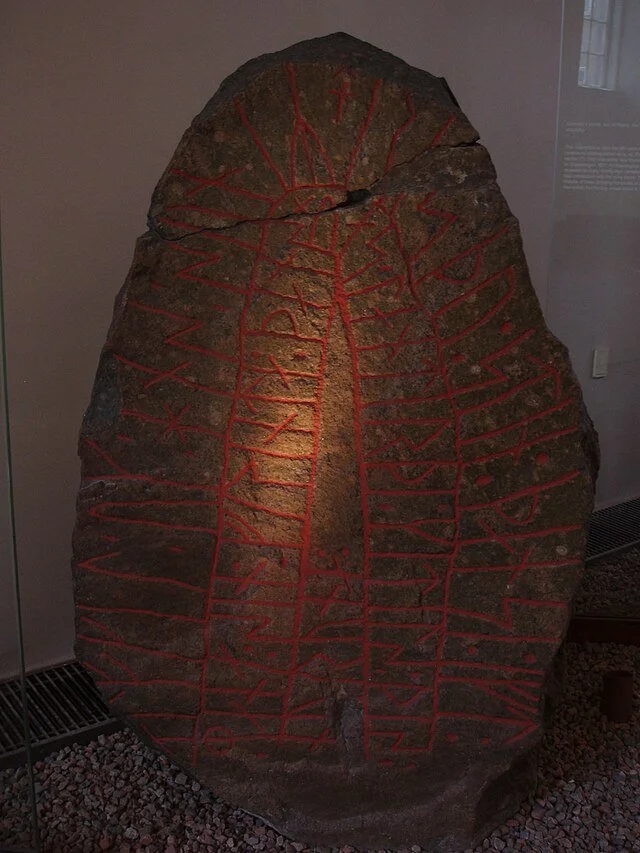
Elder Futhark Runes: The Complete Guide to Norse Rune Tattoos
Among all Norse symbols, the Elder Futhark runes remain the most frequently requested and the most misunderstood in tattoo culture. Their power, mystique, and cultural weight have inspired people for centuries—and today they are among the most personal and symbolically loaded Nordic tattoo motifs.
A Cornerstone Article of the Nordic Tattoo Master Series
There is so much to be said about the Elder Futhark runes. Songs have been written of them, stones have been carved with them, and countless lives have been guided by their symbols for over a thousand years. For many, runes carry deep personal meaning—markers of identity, intention, ancestry, and transformation. For others, they appear mysterious or foreign, their true purpose lost beneath modern misconceptions and surface-level interpretations. What often gets missed is that these symbols were never meant to be aesthetic decorations alone—they were language, prayer, oath, and story combined into form.
This article exists to dig beneath the surface of the runes and reconnect them to their historical roots and living power. Rather than offering shallow lists or trendy symbolism, the goal here is to explore what the runes truly were, how they were used, and why they still resonate so strongly today—especially in tattooing. Whether you’re drawn to a single rune, a protective bindrune, or a deeply personal Norse composition, understanding their authentic meanings adds intention and integrity to the art you carry on your skin.
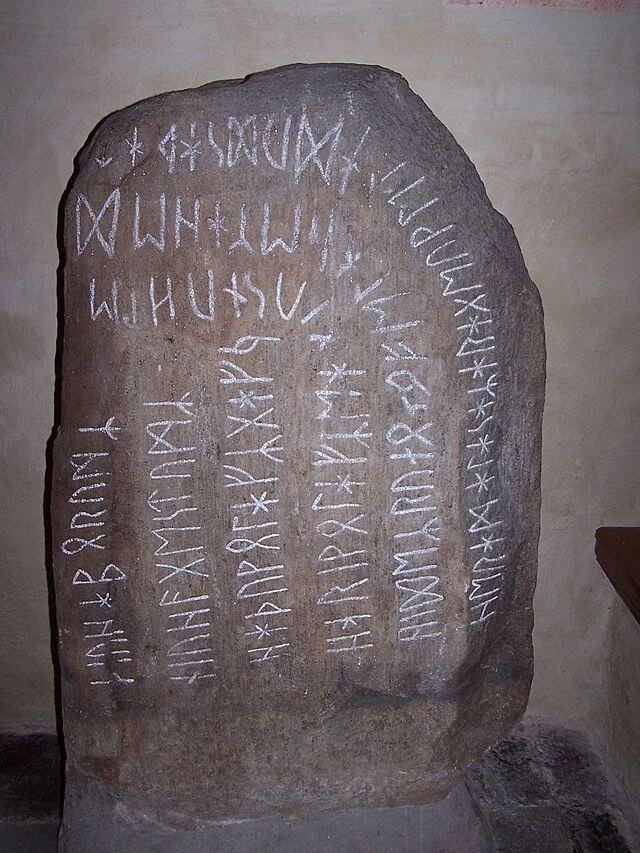
The Stentoften Runestone, an example of runes carved in stone.
Where do the Elder Futhark Runes come from?
In Norse mythology, the runes were not invented by humans… they were found.
According to the Hávamál, Odin sacrifices himself on the World Tree, hanging for nine nights “wounded with a spear, given to Odin, myself to myself.” In this trance between life and death, he glimpses the runes in the depths below, seizes them with a scream, and rises back to the world with the secrets of writing, magic, and meaning. In the mythic worldview, runes are gifts of insight pulled from the fabric of the universe — symbols of wisdom earned through sacrifice, suffering, and deep personal transformation. That’s why so many people today connect to runes not as simple letters, but as signs tied to resilience, shadow work, and awakening.
Historically, the story is different, but no less interesting.
The Elder Futhark appears across Northern Europe between the 2nd and 8th centuries CE, likely evolving from early Italic or Mediterranean alphabets adapted by Germanic tribes into their own symbolic system. Over time, runes shifted from a writing method to tools of meaning-making, ritual, memorial stones, personal identity, and magical practice. Archaeologists have found them carved into combs, weapons, amulets, jewelry, and stones from Denmark to Germany to Sweden — each inscription offering a tiny window into the culture and mindset of early Germanic peoples. So whether you look at runes through the lens of mythology or archaeology, both roads lead to the same truth: runes have always been more than markings. They are symbols of identity, intention, power, and connection — which is why they remain such powerful tattoo motifs today.
Introduction: Why Rune Tattoos Matter
Among all Norse symbols, the Elder Futhark runes remain the most frequently requested and the most misunderstood in tattoo culture. Their power, mystique, and cultural weight have inspired people for centuries—and today they are among the most personal and symbolically loaded Nordic tattoo motifs.
But the problem most clients face is this:
“What do the runes really mean? What are their true historical interpretations? And how do I avoid something inauthentic or incorrect?”
This guide answers all of that and more.
As part of the Nordic Tattoo Master Series, this article goes deeper than typical online rune lists. It is built from historical sources, archaeological references, linguistic research, and real-world tattoo experience at Ancient Marks, where clients travel nationally for custom Norse and rune-based work.
If you want a rune tattoo—whether a single rune, a protective stave, or a custom bindrune—this guide gives you a foundation built on accuracy and intention.
This guide won’t make the bindrune for you, but can serve as a guide when you bring your intentions to your artist to create a lasting personalized bindrune for you.
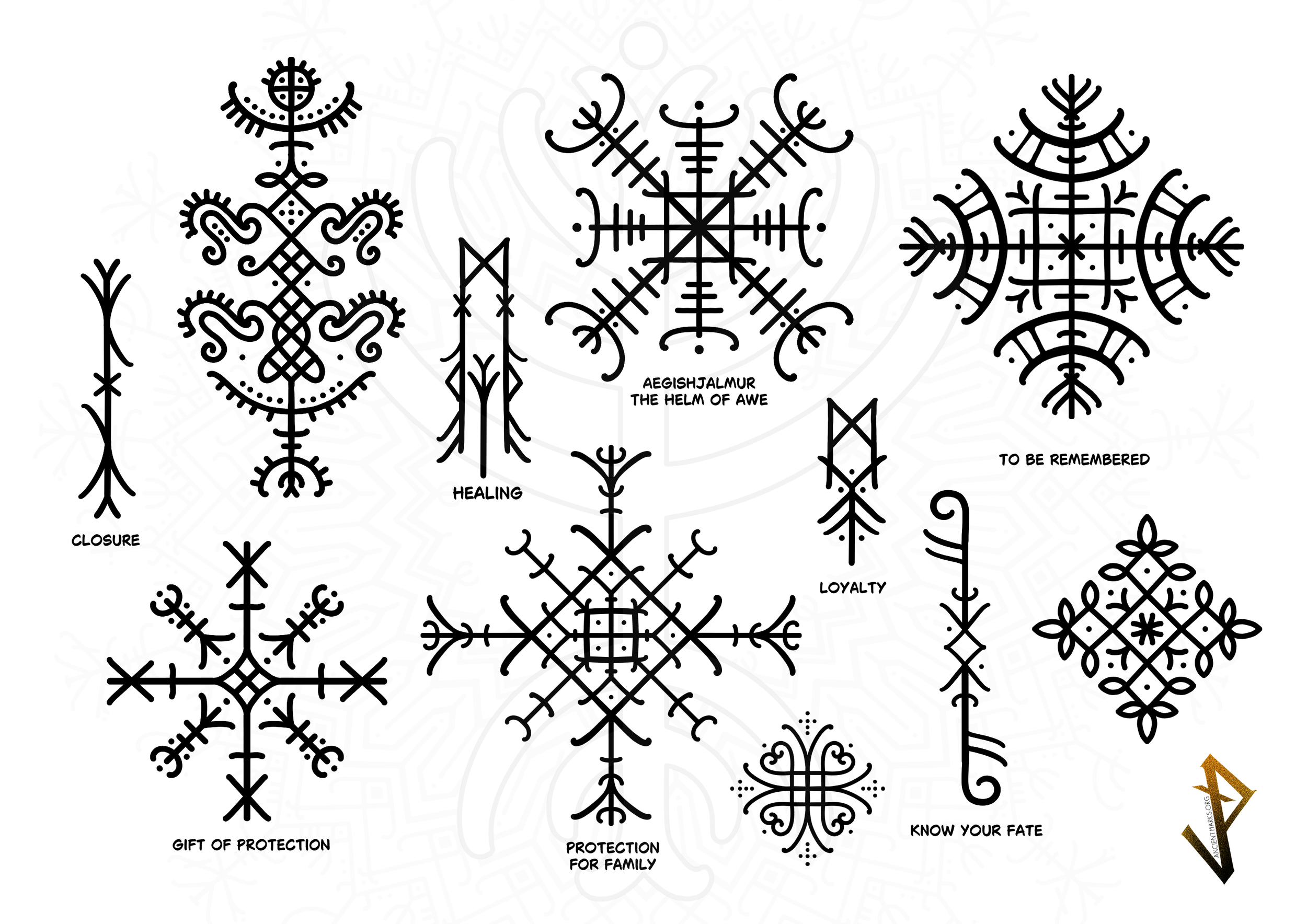
Various Sigils and Bindrunes with random designs… These are part of a FLASH set and available to you.
This artwork is ©2025 ANCIENT MARKS, LLC.
What Are the Elder Futhark Runes?
The Elder Futhark is the oldest known runic alphabet, used roughly from 150–800 CE across Scandinavia and Germanic Europe.
It contains 24 runes, divided into three families called Aetts:
Freyr’s Aett — Growth, vitality, expansion
Heimdall’s (or Hagal’s) Aett — Challenge, trials, transformation
Tyr’s Aett — Strength, order, justice, the warrior’s path
Each rune holds:
A phonetic value (sound)
A literal meaning (object or concept)
A symbolic meaning (spiritual or archetypal)
A historical context (as seen on stones and artifacts)
The runes are NOT:
A language you can “write English words” with
A direct translation system
A modern Wiccan symbol set
A simple decoration
They are an ancient writing + symbolic system that carried meaning on multiple levels. in fact, it is said that the god Oden gave his eye for the knowledge of these runes. But more on that in another blog post.
The 24 Elder Futhark Runes - Meanings & Tattoo Significance
Below is the complete set, with accurate interpretations drawn from sources such as:
The Poetic Edda
The Hávamál (Rune Poem sections)
The Kylver Stone inscription
Scholarly works by H.R. Ellis Davidson, Rudolf Simek, and Neil Price
Freyr’s Aett - Runes of Vitality, Wealth & New Beginnings
1. Fehu (ᚠ)
Literal: Cattle, wealth
Symbolic: Prosperity, success, fulfilling goals
Tattoo Meaning: Achievement, self-made success, building a life of abundance
Notes: One of the most common runes for entrepreneurs, creators, or self-starters.
2. Uruz (ᚢ)
Literal: Ancient aurochs (wild bull)
Symbolic: Strength, endurance, raw primal energy
Tattoo Meaning: Inner strength, overcoming illness, personal resilience
Notes: Powerful when paired with a protection stave.
3. Thurisaz (ᚦ)
Literal: Thorn or giant (Jötunn)
Symbolic: Defense, conflict, controlled chaos
Tattoo Meaning: Setting boundaries, facing adversity, protection
Notes: Not a “negative” rune—just potent and sharp.
4. Ansuz (ᚨ)
Literal: Odin, divine breath
Symbolic: Wisdom, communication, inspiration
Tattoo Meaning: Insight, creativity, spiritual calling
Notes: Popular for writers, teachers, and spiritual practitioners.
5. Raidho (ᚱ)
Literal: Riding, journey
Symbolic: Traveling, moving forward, life’s path
Tattoo Meaning: Momentum, life transition, spiritual pilgrimage
Notes: Strong on the forearm due to linear flow.
6. Kenaz (ᚲ)
Literal: Torch
Symbolic: Knowledge, illumination, skill
Tattoo Meaning: The spark of creation, healing, clarity
Notes: Excellent for artists, craftsmen, creators.
7. Gebo (ᚷ)
Literal: Gift
Symbolic: Generosity, partnership, exchange
Tattoo Meaning: Love, marriage, equal partnership
Notes: One of the most used runes in relationship bindrunes.
8. Wunjo (ᚹ)
Literal: Joy
Symbolic: Harmony, belonging, bliss
Tattoo Meaning: Peace, gratitude, emotional fulfillment
Notes: Works beautifully above the heart or sternum.
Heimdall’s Aett - Runes of Trials, Transformation & Challenge
9. Hagalaz (ᚺ)
Literal: Hail**
Symbolic: Disruption, cleansing, necessary destruction
Tattoo Meaning: A storm overcome; a trauma survived
Notes: Powerful transformative energy.
10. Nauthiz (ᚾ)
Literal: Need, deprivation
Symbolic: Friction, endurance, resilience
Tattoo Meaning: Strength developed under constraint
Notes: Popular for those who’ve overcome addiction or hardship.
11. Isa (ᛁ)
Literal: Ice
Symbolic: Stillness, clarity, boundaries
Tattoo Meaning: Pause, reflection, emotional control
Notes: Pairs well with meditation themes or inner stillness.
12. Jera (ᛃ)
Literal: Year, harvest
Symbolic: Cycles, reward, natural timing
Tattoo Meaning: Long-term goals, patience and payoff
Notes: Perfect for sleeve fillers with knotwork.
13. Eihwaz (ᛇ)
Literal: Yew tree
Symbolic: Death, rebirth, endurance
Tattoo Meaning: Transformation, spiritual strength
Notes: Often mistaken for “negative,” but deeply powerful.
14. Perthro (ᛈ)
Literal: Dice cup (fate, chance)
Symbolic: Mystery, destiny, hidden forces
Tattoo Meaning: Embracing the unknown, trusting fate
Notes: Popular among gamblers, seekers, and mystics.
15. Algiz (ᛉ)
Literal: Elk
Symbolic: Protection, sanctuary, divine shielding
Tattoo Meaning: Safety, guardianship, spiritual defense
Notes: One of the most popular tattoo runes of all time.
16. Sowilo (ᛋ)
Literal: Sun
Symbolic: Success, vitality, guidance
Tattoo Meaning: Triumph, healing, personal power
Notes: Often placed along the spine or sternum.
Tyr’s Aett - Runes of Strength, Justice & Purpose
17. Tiwaz (ᛏ)
Literal: Tyr, the warrior god
Symbolic: Honor, justice, self-sacrifice
Tattoo Meaning: Courage, integrity, overcoming obstacles
Notes: A favorite for police, military, athletes, or anyone fighting a battle.
18. Berkano (ᛒ)
Literal: Birch tree
Symbolic: Birth, renewal, feminine energy
Tattoo Meaning: New beginnings, motherhood, growth
Notes: Ideal for family-based bindrunes.
19. Ehwaz (ᛖ)
Literal: Horse
Symbolic: Partnership, trust, movement
Tattoo Meaning: Teamwork, loyalty, bonded relationships
Notes: Often mirrored for symmetry in tattoos.
20. Mannaz (ᛗ)
Literal: Human
Symbolic: The self, community, intelligence
Tattoo Meaning: Self-development, identity, overcoming ego
Notes: A grounding rune.
21. Laguz (ᛚ)
Literal: Water
Symbolic: Flow, emotion, intuition
Tattoo Meaning: Healing, emotional journey, adaptability
Notes: Great for fluid tattoo compositions.
22. Ingwaz (ᛜ)
Literal: Ing (fertility god)
Symbolic: Stored energy, gestation, creation
Tattoo Meaning: Creation, fertility, potential
Notes: A powerful “manifestation” rune.
23. Dagaz (ᛞ)
Literal: Day
Symbolic: Breakthrough, awakening
Tattoo Meaning: Personal transformation, enlightenment
Notes: Excellent in recovery-themed tattoos.
24. Othala (ᛟ)
Literal: Ancestral property
Symbolic: Heritage, roots, home
Tattoo Meaning: Family lineage, cultural identity
Notes: Very popular among people honoring Scandinavian ancestry.
Are Rune Tattoos “Dangerous” or Cursed?
A common myth (mostly online) claims certain runes are “dangerous,” “evil,” or “should never be tattooed.”
Nothing in the historical record supports this. hundreds of thousands of us that have runes tattooed on our skin can attest to the fact that they are infact quite save, and to the contrary, bring out the intended meanings into being by tattooing them on the skin,
Runes were tools—like letters, concepts, archetypes.
The “danger” comes only from ignorance or misuse.
Tattooing them with knowledge and intention is respectful and safe. And can have tremendous benefits.
The Power of BindRunes (Custom Personal Sigils)
A BindRune is a combination of two or more runes merged into a single sigil.
This tradition is historically supported, although the exact methods varied. Today, BindRunes in tattoos allow clients to combine personal meanings such as:
Strength + protection
Love + partnership
Healing + growth
Journey + self-discovery
Ancestry + purpose
At Ancient Marks, bindrunes are:
Custom drawn
Balanced for aesthetic flow
Energetically aligned to the client
Integrated into larger Nordic tattoo designs
If you want a highly personal Nordic tattoo, a bindrune is one of the strongest paths, and can easily be added to, or can be used to fill a space.
Tattoo Placement & Design Considerations
Composition matters, Authenticity matters, but flow matters most of all.
Runes can integrate beautifully on:
Fingers
Forearms
Ribs
Spine
Wrist
Behind ear
Sternum
Part of larger Norse sleeves
Individually, or repeated nside knotwork or other Lattice work on a larger piece
Included in armor-style designs
As the center of a symbol or Sigil (Vegvísir, Helm of Awe)
As part of a Jörmungandr - Sleeve or Back Piece
===========================================
Author Bio - Jon Poulson, Ancient Marks
Jon Poulson is the founder of Ancient Marks, and one of the few tattoo artists in North America specializing in historically grounded Norse, Celtic, and ancestral tattoo styles. With over 20 years of experience in this style, Jon creates custom story-driven designs rooted in authentic symbolism, cultural respect, and artistic excellence. Clients travel nationally for Nordic-inspired work, bind-runes, and large-scale, geometric inspired and Tribal style tattoos.