
The Helm of Awe (Ægishjálmur): Fearlessness, Protection & Warrior Magic
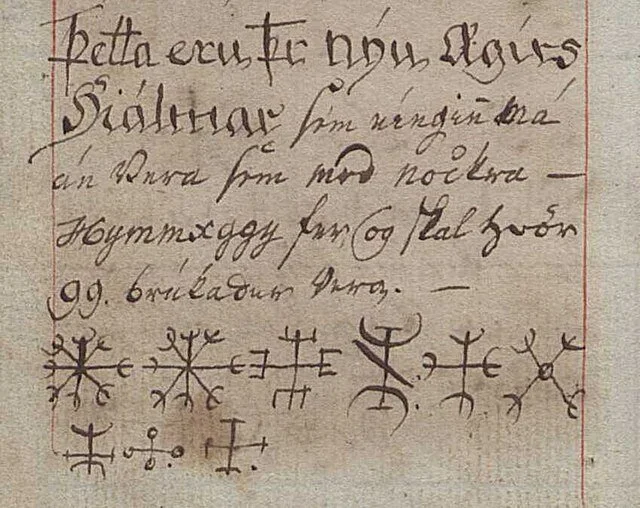
The Helm of Awe—Ægishjálmur—is one of the most powerful symbols in Icelandic magical tradition, and easily one of the most misunderstood in modern tattoo culture. It’s not a Viking shield-boss, and it’s not a battle emblem carved onto helmets; instead, the symbol comes from later Icelandic grimoires where it was drawn, spoken, or worn as magical protection. At its core, the Helm of Awe represents courage, mental fortitude, and the ability to face fear without backing down. In the sagas, warriors use “ægishjálmr” as an inner state—an overwhelming presence or psychological advantage that breaks an enemy’s will. It’s less about physical strength and more about a focused, unshakable mind.
In tattoo form, people choose the Helm of Awe when they’ve walked through fear, trauma, or uncertainty and come out stronger on the other side. It becomes a personal anchor—something that represents the moment you refused to be intimidated by life. Some clients pair it with runes that reflect their own journey, while others keep it clean and bold as a standalone stave. It works beautifully on the sternum, chest, upper back, or as part of a larger Nordic tattoo. Whether simple or detailed, the Helm of Awe is a symbol for people reclaiming their strength from the inside out.
Icelandic Stave Magic
Ægishjálmur: The Helm of Awe
There are symbols that get your attention, and then there are symbols that stare straight back at you. The Helm of Awe — Ægishjálmur — is one of those symbols.
Bold. Radiating. Commanding.
You don’t just look at it. You feel it.
But the truth behind this symbol is almost always misunderstood. People call it “Viking,” or imagine warriors carving it on shields or helmets. That’s not quite accurate.
The Helm of Awe is powerful — but its power comes from Icelandic magical tradition, not Viking Age warfare. And that distinction matters if you want your tattoo to carry meaning, not mythologized misinformation.
What Ægishjálmur Actually Is
The name comes from:
ægis — awe, fear, dread, respect
hjálmur — helm, covering, protection
So the meaning is roughly:
“The Helm (or Mask) of Awe.”
It shows up primarily in Icelandic grimoires — magical manuscripts — between the 1500s and 1800s. Like the Vegvísir, it’s part of the galdrastafir tradition, not something directly attested in the Viking Age.
But its mythic associations run deep.
The Mythological Connection to Fáfnir
The Helm of Awe is referenced in Fáfnismál (Poetic Edda), where the dragon Fáfnir says:
“The Helm of Awe I wore before the sons of men,
in defense of my treasure.”
Most scholars agree this “helm” was metaphorical — a terrifying aura, a psychological presence, a projected force, not a physical metal helmet.
In other words:
The Helm of Awe was the fear you inspired, not the thing you wore.
That interpretation deeply influences how people use this symbol today.
Symbolism of the Helm of Awe
Even though it’s Icelandic folk magic rather than Viking magic, Ægishjálmur carries immense symbolic weight that resonates with modern tattoo clients.
Protection
Not physical protection — psychological protection.
The Helm of Awe was said to:
Guard the mind
Strengthen will
Repel threats
Shield the wearer from spiritual or emotional attack
It’s a mental armor.
Fearlessness
The symbol was used to confront fear itself.
To “wear” the Helm of Awe was to step into danger without flinching.
For people overcoming trauma, addiction, or loss, this resonates deeply.
Strength in adversity
In Icelandic manuscripts, it’s associated with:
Boldness
Mental fortitude
Psychic resistance
Inner stability
People often get this tattoo during life transitions — the kind where you have to steady your mind just to keep moving.
Confronting one’s shadow
The Helm forces you inward.
It’s not about scaring enemies — it’s about facing the darker parts of yourself.
Some clients choose it to represent the work they’ve done (or are doing) in therapy, recovery, or self-discovery.
Identity & reclaiming power
You don’t wear Ægishjálmur casually.
It carries a clear statement:
“I know who I am. And I’m not afraid anymore.”

Make it Yours
These staves were meant to be individualized. Too many people just get what they saw on google. I'm here to change that.
I will put this symbol on you, but only after we make it unique.
here is an example of a customized Helm of Awe from the Author, and Artist Jon Poulson.
Ægishjálmur in Tattoo Design
The symbol itself is clean and bold, but its simplicity hides incredible versatility. Here are common directions I explore with clients.
Traditional Blackwork Helm of Awe
Straightforward, sharp lines, high contrast.
Perfect for sternum, chest, upper back, or forearm.
Helm of Awe + Runes
A ring of Elder Futhark runes can amplify specific aspects of the symbol:
Algiz for protection
Tiwaz for courage
Sowilo for success and light
Eihwaz for resilience
This combination is one of the strongest directional tattoos for mental resilience.
Helm of Awe + Vegvísir
Guidance + Courage
Wayfinding + Fearlessness
Direction + Protection
A very intentional pairing.
Integrated into Knotwork or Shields
Not historically Viking, but aesthetically powerful.
Clients who want a “Viking armor” vibe often use this as the center of a chest piece.
Helm of Awe with Raven Imagery
The ravens can represent:
Mental clarity
Overcoming fear
Odin’s influence
Self-observation
Great for shoulder cap or upper back pieces.
Minimalist Line Weight Variation
Subtle line thickness changes make the symbol feel more refined and modern.
This version fits well behind the ear or on the ribs.
Full Saga Scene Integration
The Helm sits above a scene like:
The binding of Fenrir
Odin in shamanic form
Yggdrasil’s roots
A Viking longship in storm
This kind of work creates a powerful lower-torso or sternum narrative.
Why People Choose the Helm of Awe Today
In the studio, clients who choose Ægishjálmur often share similar stories. It usually ties to a personal battle — something they fought through quietly, internally.
Common themes I hear:
“I’m rebuilding myself.”
“I faced something dark and I’m still here.”
“I refuse to be afraid anymore.”
“My anxiety doesn’t control me.”
“This is my symbol of strength.”
“I’m done letting the past run my life.”
“I’m stepping into who I really am.”
It’s a symbol of reclaimed power.
A mental shield.
A declaration of courage.
And when tattooed with intention, it becomes almost ceremonial.
Placement Suggestions
Center chest (the most popular)
Solar plexus (deep symbolic resonance)
Upper back
Forearm
Shoulder cap
er 20 years of experience, Jon creates designs grounded in cultural depth, intention, and personal meaning. Clients travel nationwide for Nordic-inspired tattoos, including the Helm of Awe.
===========================================
Sources & Citations
Primary Sources
Poetic Edda, Fáfnismál — earliest mention of “ægishjálmr” in a mythic context
Huld Manuscript (ÍB 383 4to), 1860 — Icelandic magical stave depiction
Galdrabók — Icelandic grimoire containing related stave magic
Sternum
Spine (as part of a larger design)
Inside a Vegvísir circle
Within knotwork borders
Academic Commentary
Flowers, Stephen — Galdrabók: An Icelandic Grimoire
Simek, Rudolf — Dictionary of Northern Mythology
Davidson, H.R. Ellis — Gods and Myths of Northern Europe
Price, Neil — The Viking Way
Cultural Insight
Terry Gunnell — research on Icelandic magical staves
Jackson Crawford, PhD — commentary on Old Norse texts and stave traditions
===========================================
Author Bio - Jon Poulson, Ancient Marks
Jon Poulson is the founder of Ancient Marks, and one of the few tattoo artists in North America specializing in historically grounded Norse, Celtic, and ancestral tattoo styles. With over 20 years of experience in this style, Jon creates custom story-driven designs rooted in authentic symbolism, cultural respect, and artistic excellence. Clients travel nationally for Nordic-inspired work, bind-runes, and large-scale, geometric inspired and Tribal style tattoos.
