
Valknut: Odin’s Knot of the Slain & Warrior Symbolism
Few people know the historical reality behind the Valknut, or the incredible depth of meaning that makes it one of the most potent symbols in all of Norse mythology.
This article is part of the Nordic Tattoo Master Series and is designed for clients who want tattoos rooted in meaning, authenticity, and ancestral symbolism.
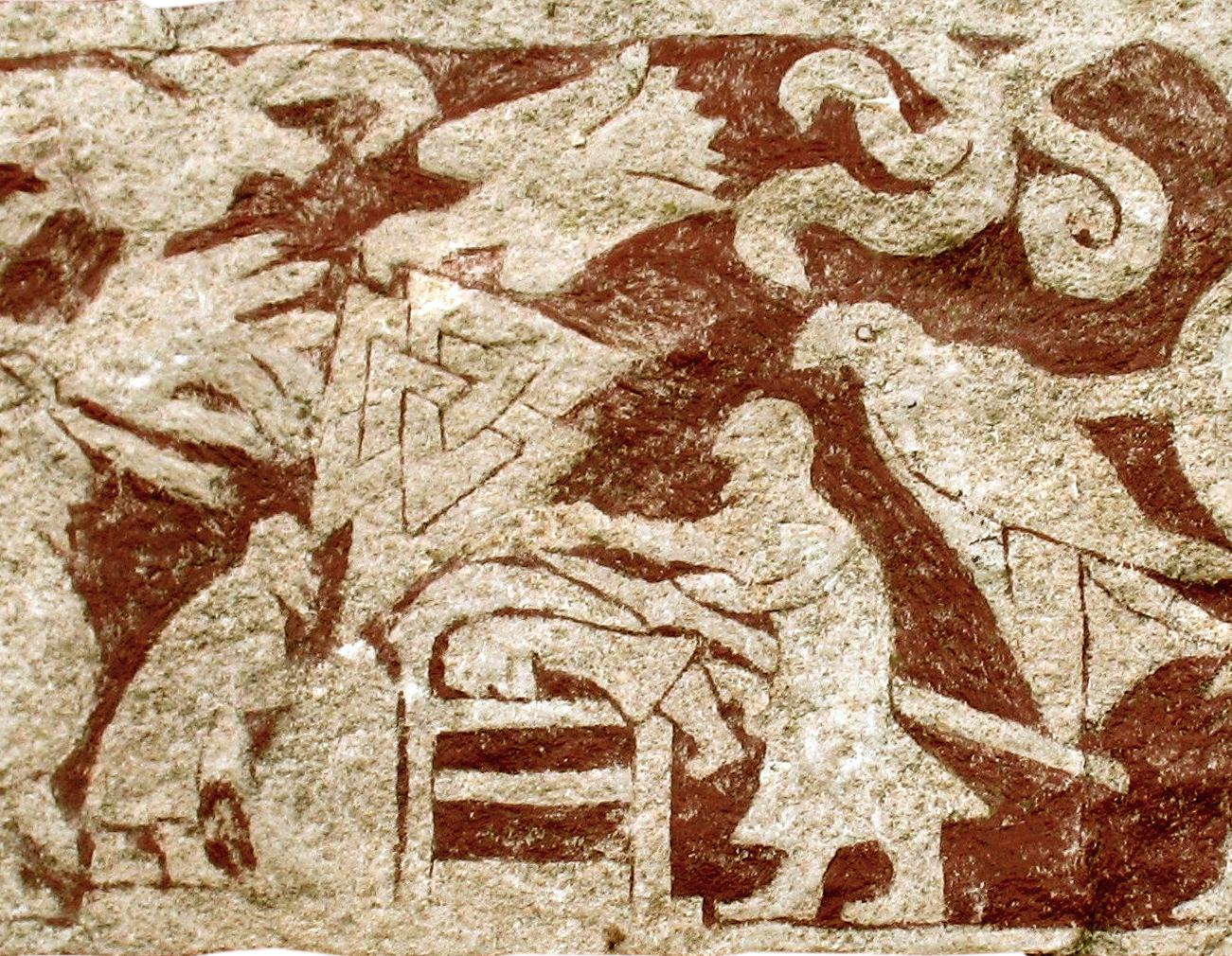
Closeup of the Valknut on the Sacrificial panel of the Hammars Stone, located in Stora Hammars, Gotland, Sweden.
Valknut: The Knot of the Slain
The Valknut is one of those symbols people recognize instantly, but very few actually understand. It shows up everywhere; tattoos, jewelry, clothing, video games—but its real story comes from archaeology, not pop culture. The Valknut appears beside warriors, rituals, and scenes connected to Odin, death, and the transition between worlds. Even though the name “Valknut” is modern, the symbol itself is ancient, and every historical example ties back to themes of fate, courage, transformation, and the mysteries of life and death. That’s why it’s such a meaningful tattoo for people who’ve fought their own battles, survived something life-changing, or feel connected to Odin’s path as a seeker, wanderer, and guide of the slain.
For tattoo clients, the Valknut becomes more than three interlocking triangles—it becomes a personal statement. Some choose it to honor a loss, some to mark their own transformation, and others to embrace fate with courage instead of fear. It fits beautifully into blackwork, geometric, tribal-inspired pieces, or as part of a larger Norse sleeve alongside ravens, runes, or Jörmungandr. No matter how it’s styled, the Valknut carries a depth that resonates with people who walk forward with intention, strength, and respect for the old ways.
What Is the Valknut?
The term “Valknut” is modern. It comes from the Norwegian words:
valr — “the slain”
knútr — “knot”
So the modern translation is:
“knot of the slain” or “slain warrior’s knot.”
While the word is modern, the symbol itself is ancient.
Where the Valknut Actually Appears Historically
The Valknut appears in several archaeological contexts, including:
1. The Stora Hammars Stones (Gotland, Sweden)
A series of picture stones showing battle scenes, sacrifice, and possibly Odin receiving the dead.
2. The Tängelgårda Stone (Gotland)
A mounted warrior, or possibly Odin himself, depicted alongside Valknut-like symbols.
3. The Oseberg Ship Burial (Norway)
Carved wood finds include motifs visually similar to the Valknut.
4. Anglo-Saxon Rings & Artifacts
A similar triple-triangle motif (Hrungnir’s heart) appears in Germanic art.
Notably:
The Valknut appears next to warriors, rituals, and gods
It appears in contexts of death, battle, rebirth, or Odin
It is never accompanied by written explanations
This lack of explanatory text is why scholars still debate its meaning.
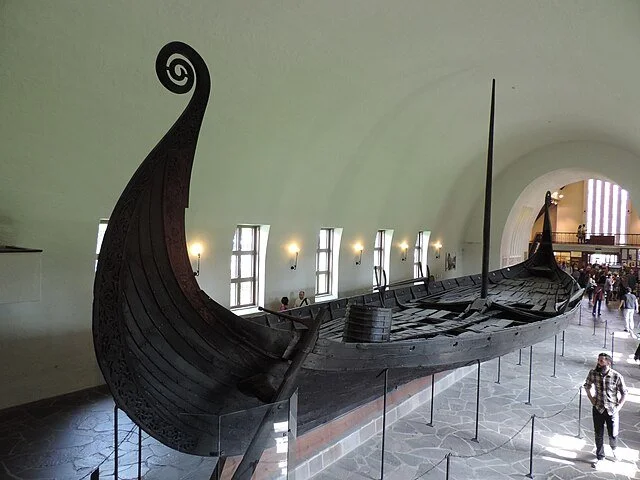
The Oseberg Ship
An Archeological find that preserved the intricate wood carvings typical of the Viking age, including carvings of the Valknut
What Did the Valknut Mean to the Norse?
(And what does it mean for tattoo seekers today?)
There is no surviving medieval description of the symbol. But based on its archaeological context, scholars have proposed three main interpretations — all deeply relevant to tattoos.
1. Odin’s Power Over Death
The Valknut appears repeatedly near depictions of Odin.
Odin is:
God of the slain
Keeper of the Valr (war-dead)
Chooser of who lives and dies in battle
Leader of the Einherjar
God of wisdom, sacrifice, and the unknown
The symbol may represent:
The passage between life and death
Odin’s ability to bind or unbind the mind
Acceptance of fate
Courage in the face of death
Tattoo Interpretation:
Strength, fate, fearlessness, the warrior mindset, and honoring those lost.
2. The Nine Worlds or Tripartite Cosmology
Three interlocking triangles = symbolic triads.
Possibilities include:
Earth, Heaven, and Hel
The past, present, future
Mind, body, spirit
The three Norns
Three aspects of Odin (Traveler, Warrior, Seeker of Wisdom)
Tattoo Interpretation:
Balance, cycles, interconnectedness, and wisdom.
3. Hrungnir’s Heart
Snorri Sturluson describes the giant Hrungnir having a heart made of:
“a three-pointed symbol… sharp-edged.”
(Prose Edda, Skáldskaparmál)
Some scholars link this description to early Valknut-like shapes.
Tattoo Interpretation:
Unyielding strength, toughness, endurance.
Valknut Tattoos: Symbolism for Modern Wearers
Today, the Valknut is chosen by people seeking:
1. Warrior Energy
Not violence — but the inner warrior:
Persistence
Courage
Resilience
Honor
Those who’ve survived battles — literal or metaphorical — often resonate with the Valknut.
2. Connection to Odin
Odin is not just a warrior god:
He is a seeker of knowledge
A wanderer
A shamanic figure
A god of poetry, inspiration, and the unknowable
For tattoo clients who resonate with Odin’s path, the Valknut becomes an anchor.
3. Memorial & Ancestral Tattoos
Because the Valknut is linked to the slain, it’s powerful for:
Honoring ancestors
Remembering loved ones
Marking personal transformation after loss
4. Embracing Fate (Wyrd)
To the Norse, fate was not doom — it was purpose.
The Valknut symbolizes:
“I accept my path. I walk forward with courage.”
Design Variations: How Valknut Tattoos Can Look
1. Closed (Unbroken-Line) Valknut
Three triangles interwoven by a continuous line
Symbolizes unity, continuity, and cycles
Popular for chest and sternum tattoos
2. Open-Line Valknut
Three separate triangles interlocked
Represents choice, individuality, and crossing boundaries
Works well in geometric or blackwork styles
3. Valknut with Runes
Can incorporate Elder Futhark runes representing:
Strength (Uruz)
Victory (Tiwaz)
Protection (Algiz)
Ancestry (Othala)
See the Elder Futhark blog for a deeper rune guide (internal link below).
4. Valknut with Ravens (Huginn & Muninn)
Symbolizes:
Memory
Thought
Odin’s presence
Wisdom
Beautiful for upper-back or shoulder work.
5. Valknut with Jörmungandr
The endless serpent wrapped around the Valknut represents:
Endless cycles
Protection
The cosmic tension between order and chaos
6. Valknut Chest Piece
Centered on the sternum - a popular placement for people embracing:
Courage
Masculine or warrior energy
Central identity symbolism
Common Misconceptions About the Valknut
— “It was a Viking gang symbol or clan marker.”
No evidence supports this.
— “It’s dangerous or cursed.”
No medieval sources say this.
— “It’s Neo-Nazi.”
Historically, the Valknut is 2,000+ years old.
A symbol’s misuse does not negate its original meaning.
At Ancient Marks, the goal is always to reclaim symbols with education, respect, and cultural honesty.
Tattoo Placement Ideas
Sternum
Center chest
Forearm
Back between shoulder blades
Bicep
Thigh
Part of a Norse sleeve
Integrated with ravens or runes
Behind the ear (small minimalist variant)
Palm (for the bold!)
Over the heart (honoring the slain)
Sources & Citations
Primary & Historical Sources
Stora Hammars I & II Stones, Gotland — Viking Age picture stones with Valknut-like symbols
Tängelgårda Stone, Gotland — figure associated with Valknut imagery
Snorri Sturluson — The Prose Edda (particularly Skáldskaparmál)
Oseberg Ship Burial, Norway — wood carvings showing Valknut-like triadic motifs
Academic Secondary Sources
Davidson, H.R. Ellis — Gods and Myths of Northern Europe
Simek, Rudolf — Dictionary of Northern Mythology
Price, Neil — The Viking Way: Magic and Mind in Late Iron Age Scandinavia
Lindow, John — Norse Mythology: A Guide to Gods, Heroes, Rituals, and Beliefs
Page, R.I. — Runes and Runic Inscriptions
Archaeological & Museum Sources
Swedish History Museum (Historiska Museet), Stockholm — Viking Age picture stones
University of Oslo, Cultural History Museum — Oseberg artifacts
===========================================
Author Bio - Jon Poulson, Ancient Marks
Jon Poulson is the founder of Ancient Marks, and one of the few tattoo artists in North America specializing in historically grounded Norse, Celtic, and ancestral tattoo styles. With over 20 years of experience in this style, Jon creates custom story-driven designs rooted in authentic symbolism, cultural respect, and artistic excellence. Clients travel nationally for Nordic-inspired work, bind-runes, and large-scale, geometric inspired and Tribal style tattoos.
