
Vegvísir, “Viking Compass” or Icelandic Wayfinder? A Deep Guide for Tattoo Seekers
The Vegvísir might be one of the most popular “Viking” tattoos on the planet—yet historically, it is not a Viking Age symbol.
If you’ve seen it labeled as a “Viking compass” on Pinterest or Google Images, you’re looking at a modern myth wrapped around a very real and fascinating symbol from Icelandic magical tradition, not from the time of longships and raiding parties.
This article is written for people who are:
Considering a Vegvísir tattoo
Want to understand the real history behind it
Care about using Nordic and Icelandic symbols respectfully
Looking for design ideas that go beyond generic stencil flash
As with the rest of this Nordic Tattoo Master Series, the goal is to give you enough depth that your tattoo isn’t just trendy—it’s intentional.
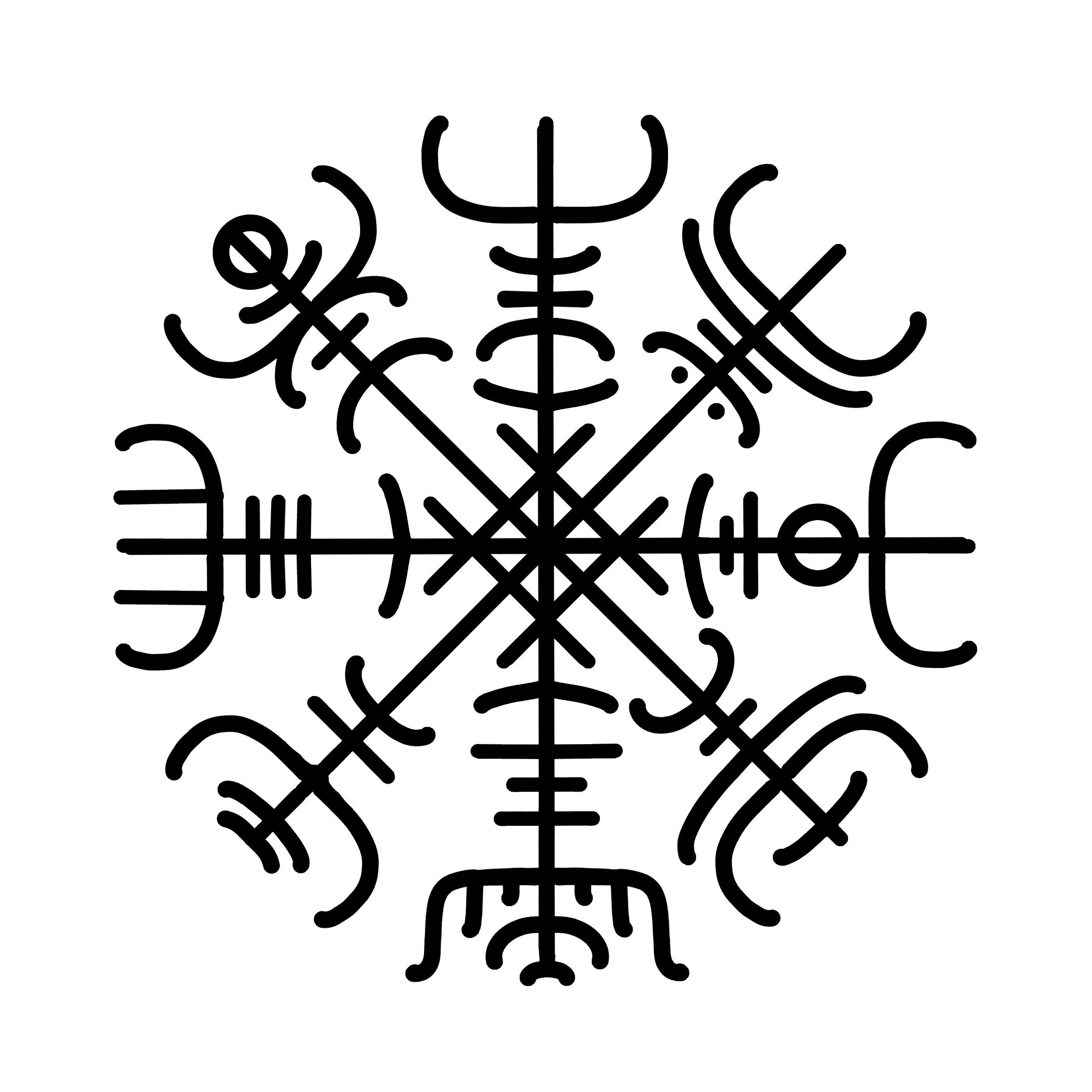
Customize your Vegvísir.
An example of a custom drawn Vegvisir by Jon Poulson. There are infinite ways to make this symbol your own, and bring your own magic into its arms.
What Is the Vegvísir, Really?
The word “Vegvísir” is Icelandic and roughly translates to “that which shows the way” or simply “wayfinder.”
The symbol appears in a handwritten book of Icelandic magical signs called the Huld Manuscript, compiled by Geir Vigfússon in 1860. In that manuscript, the Vegvísir is drawn with a short description saying that if this sign is carried, “one will never lose one’s way in storms or bad weather, even when the way is not known.”
Key points:
Date: 19th century Icelandic source, - Read that correctly… it is not from the Viking Age
Type: Magical stave (galdrastafur), not an Elder Futhark rune word
Function: Protection from getting lost, especially in storms or rough journeys
So while it is Norse-adjacent (Icelandic culture descended from medieval Norse), it’s technically a piece of post-medieval Icelandic folk magic, not something documented on Viking Age stones or artifacts.
That doesn’t make it less powerful as a tattoo symbol—if anything, understanding its true context gives it more integrity.
Why Everyone Calls It the “Viking Compass”
In modern pop culture, Vegvísir is everywhere:
“Viking compass” stickers
Jewelry
Clothing
And, of course, tattoos
The “compass” idea comes from:
The radial shape (a central circle with eight arms radiating outward)
The guidance/protection text in the Huld Manuscript
The modern romantic association with Viking navigation and sea journeys
However, historians and rune scholars regularly point out that:
There is no surviving Viking Age source showing Vegvísir
The symbol is only attested in later magical manuscripts like the Huld manuscript and a couple of related Icelandic grimoires
So, if you choose this as a tattoo, it’s more accurate to think of it as:
An Icelandic magical wayfinder stave
that has become part of modern Norse-inspired visual culture
And that’s still a beautiful, powerful thing.
Vegvísir vs. Helm of Awe (Ægishjálmur)
Vegvísir is frequently confused or paired with another Icelandic stave:
the Helm of Awe (Ægishjálmur).
Vegvísir: protection from getting lost; guidance through storms and uncertainty.
Ægishjálmur: psychological and magical protection, intimidation of enemies, and mental strength in the face of fear.
Both show up in Icelandic magical stave traditions (galdrastafir), where stylized diagrams were believed to invoke specific protections or advantages.
In tattoo terms:
Vegvísir tattoos tend to be about journey, life direction, and “not losing your way”
Helm of Awe tattoos tend to be about courage, fearlessness, and facing threats or trauma
Many clients combine them when they want both guidance and protection, but they are distinct symbols with different original intentions.
Symbolic Meanings of Vegvísir Tattoos
Even though its exact historical use is limited to a few manuscripts, the Vegvísir has become a powerful modern symbol with several layers of meaning:
Guidance Through Uncertainty
The original manuscript line—“one will never lose one’s way in storms or bad weather”—naturally translates into modern life storms:
Mental health struggles
Life transitions
Recovery or sobriety journeys
Big decisions and identity shifts
Clients often choose the Vegvísir as a visual anchor that says:
“No matter how rough things get, I will find my way.”
Spiritual Compass
Because of its radial form, many people interpret the Vegvísir as a spiritual compass:
Staying true to oneself
Following an inner calling
Aligning with a path or purpose
In tattoo form, it can represent a commitment to walking your own path.
Traveler’s Protection
For some, especially those who travel a lot for work or lifestyle, a Vegvísir tattoo becomes a modern talisman for:
Safe flights and journeys
Moving between countries or states
A life spent “on the road”
This connects nicely with the original “wayfinding” intention in rough conditions.
Ancestral or Cultural Connection
For people with Icelandic or broader Scandinavian roots, Vegvísir can be:
A nod to family heritage
A bridge between folk magic and modern identity
A way to honor ancestors while still being honest about historical context
When combined with runes, knotwork, or Yggdrasil imagery, it can become the center of a larger ancestral tattoo.
Historical Honesty vs. Modern Myth
A big part of working with Nordic symbols responsibly is being honest about what we know and what we don’t.
What historical research currently supports:
Vegvísir appears in the Huld Manuscript (1860) with a short explanation indicating it’s for wayfinding in storms.
It is one of several magical staves used in Icelandic folk magic texts.
There is no confirmed Viking Age depiction of this symbol on stones, weapons, or ship carvings.
What’s more modern and romanticized:
Calling it a “Viking compass” used by longship captains
Claims that ancient Vikings universally tattooed it on themselves
Attributing it directly to Odin or Thor, which no primary source confirms
As an artist, I’m not interested in gatekeeping—but I am interested in giving clients the truth so they can make informed choices.
Vegvísir in Tattoo Design: Placement & Style Ideas
The Vegvísir works incredibly well for tattoos because of its radial symmetry and clear graphic structure.
Popular Placements
Center of the chest or sternum – as a literal spiritual “compass over the heart”
Upper back / between the shoulder blades – like a protective seal
Forearm or inner forearm – easy to see and orient to
Knee, elbow, or shoulder cap – the round shape fits joints nicely
Palms or hands (for those comfortable with highly visible tattoos)
Style Directions
Traditional Blackwork Vegvísir
Solid black lines, minimal shading
Looks strong and timeless
Often combined with runic inscriptions around the edge
Vegvísir with Knotwork Ring
Symbol at the center
Surrounded by Norse knotwork or Urnes-style interlace
Great for chest, upper back, or shoulder cap
Vegvísir + Runes (Elder Futhark)
Add a ring of runes that represent key values or personal intentions
Can integrate bindrunes at the cardinal points
For more on runes, see the Elder Futhark article in this series (linked on my blog page)
Vegvísir + Yggdrasil (World Tree)
Wayfinder set above or below a stylized World Tree
Excellent for full back or vertical chest pieces
Turns into a full “cosmic roadmap” – roots, trunk, branches, and compass
Vegvísir + Helm of Awe (Two-Stave Design)
One symbol on each side of the chest
Or Vegvísir over the heart, Helm of Awe over the solar plexus
Direction + courage combined
Common Mistakes with Vegvísir Tattoos
Incorrect Symbol Layout
Random Pinterest designs sometimes:
Mis-draw the arms
Drop or distort key lines
Blend it poorly with inconsistent rune rings
Because Vegvísir is a specific magical stave, distortion changes the symbol, how it works, and really can bring about unintended consequences (if you believe in those things).
Labelling It Purely “Viking”
If you care about accuracy, you don’t have to pretend this was carved on a longship. Instead, you can proudly say:
“This is an Icelandic wayfinder stave from later folk magic, used as a symbol of guidance and protection.”
That honesty itself becomes part of your integrity story.
Overcrowding with Random Runes
Runes are not clipart. They’re part of a complex writing and magical system.
If you want runes included, they should be:
Chosen with intention
Correctly drawn
Ideally combined in thoughtful bindrunes rather than random strings
(See my Elder Futhark article on my blog page for a deeper guide to runic tattoos.)
Designing Your Vegvísir Tattoo at Ancient Marks
At Ancient Marks, I treat Vegvísir tattoos as collaborative, custom projects, not just something copied off the internet.
When we design your piece, we’ll typically explore:
Your story: What “storms” or transitions are you navigating?
Your intention: Direction? Protection? Healing? New beginnings?
Your ancestry (if relevant): Icelandic, Scandinavian, or simply a deep draw to the mythos
Your body flow: Where will the symbol move best with your muscles and posture?
Your visual taste: Clean blackwork, old-world shading, runic framing, or fully integrated saga scene
From there, I will sketch concepts and refine until the Vegvísir feels right… then it feels like it’s yours, not just “a symbol from the internet.”
===========================================
Author Bio - Jon Poulson, Ancient Marks
Jon Poulson is the founder of Ancient Marks, and one of the few tattoo artists in North America specializing in historically grounded Norse, Celtic, and ancestral tattoo styles. With over 20 years of experience in this style, Jon creates custom story-driven designs rooted in authentic symbolism, cultural respect, and artistic excellence. Clients travel nationally for Nordic-inspired work, bind-runes, and large-scale, geometric inspired and Tribal style tattoos.
